

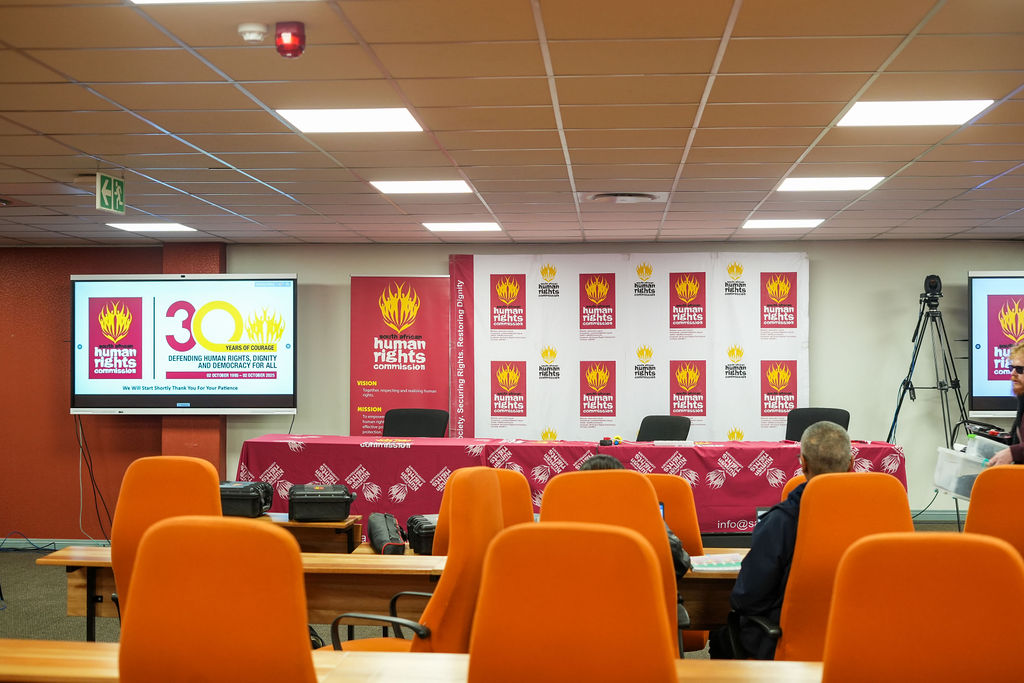
CIVIL SOCIETY, ACADEMIA AND DEVELOPMENT PARTNERS ROUNDTABLE DISCUSSION
On 29–30 July 2026, the Union Against Hunger (UAH) joined a roundtable discussion convened by the Department of Agriculture in Pretoria with civil society, academia and development partners, to discuss the draft National Food and Nutrition Security Plan (NFNSP). There is much to welcome in the latest draft of the Plan, but several aspects need urgent attention.
The Plan is framed by a Problem Statement that acknowledges the unacceptable context and key drivers of hunger in South Africa:
(1) hunger and malnutrition persist, despite national food sufficiency;
(2) there is a rising burden of child undernutrition and over-nutrition;
(3) poverty, unemployment and high prices are causing inequitable access to food;
(4) access to land, production systems, and market power are structurally unequal;
(5) local food systems are weak and informal markets are underdeveloped;
(6) food system governance is fragmented and poorly coordinated.
How well does the current version of the NFNSP address these fundamental challenges? There are some improvements on previous drafts, and on the previous Plan. This NFNSP is grounded in a comprehensive food systems – but not rights-based – approach, with three goals: (1) Transform local agri-food systems to be sustainable, diversified, and inclusive. (2) Ensure equitable access to nutritious, safe, affordable food. (3) Mitigate risks through social, livelihood, and nutrition protection. UAH endorses these goals, but they must be explicitly rights-based.
Following inputs by UAH and partners on earlier drafts, street traders and spaza shops are now recognised as positive actors in local food environments. Agroecological farming practices are acknowledged as deserving of support, especially for smallholder farmers. The need to regulate corporate food actors is accepted – but no specific measures are put forward that would curb corporate power and build an equitable food system. A Food Affordability Policy is advocated to reduce and stabilise food prices – but this requires intervening in markets (e.g. with price caps, subsidies and establishing food reserves) in ways that government has been reluctant to do.
A National Food and Nutrition Security Council is promised, to oversee implementation and coordination of the Plan. This is essential, and something that UAH has been calling for. The Council was included in the previous NFNSP (2018–2023), but never established. Questions remain unanswered over the Council’s mandate, powers, and membership. Civil society must be strongly represented. UAH argues that Brazil’s CONSEA model (National Council for Food and Nutrition Security) should be followed, with two-thirds of Council members representing civil society (social movements, smallholder farmers, indigenous peoples, academics), and one-third representing government ministries. South Africa’s Food Council must coordinate across sectors and ministries (e.g. with DFFE’s Food Loss and Waste Policy), it should have strong decentralised institutions at provincial and local levels – why have Provincial and Municipal Councils been deleted from this draft? – and it must advise the President directly on how to address the crisis of hunger.
The Plan emphasises chronic undernutrition – measured by stunting in children under 5, currently at an unacceptably high 29% – but pays inadequate attention to periodic gaps in food access. Seasonal food insecurity of farmworkers is mentioned, but no interventions to address seasonality – such as redistribution of land to farm workers for food gardens – are proposed. Projects are being piloted (not yet scaled up) for learners who have no access to school meals during school holidays. ‘Last week of the month’ hunger, reported by social grant recipients, can be addressed by raising grants to nutritionally adequate levels, not only to “the minimum food poverty line” as proposed in the Plan. Hunger is complex, and addressing just these three issues will require effective collaboration between the Departments of Agriculture, Land Reform and Rural Development, Basic Education, and Social Development.
UAH argues that framework legislation is urgently needed to give effect to the right to food, and to ensure that government can be held accountable for delivering on the promises in the Plan. The draft NFNSP notes that: “A Food and Nutrition Security Bill should be drafted”, but a strong commitment to prioritise this is lacking. The Union Against Hunger and partners will campaign vigorously for a Food and Nutrition Security Bill to be drafted, followed by an Act, as rapidly as possible.
The decision to make the NFNSP a 10–year rather than 5–year plan, starting in 2027 – after a 4–year gap with no Plan – with no additional budget mobilised for 2027 or subsequent years, is problematic. The lack of a dedicated budget was identified as a major reason for the failure of the 2018–2023 Plan. A 10-year horizon with inadequate resources risks another decade of under-delivery, while 10,000–11,000 children continue to die from malnutrition every year. Two interim review dates are included – in 2029 and 2033 – which must be used as opportunities for course correction and accountability, with civil society involvement.
There is little sense of urgency in this Plan, which is being debated just as a “Super” El Niño – which is projected to push tens of millions of people globally into acute hunger – is about to hit South Africa. Disaster risk reduction and climate change are mentioned several times, but the El Niño is not. If this Plan is implemented, by 2037 food distribution centres will be built, social grants will be “reviewed”, and resilience to climate shocks will be strengthened – but none of these are in place now, when they urgently needed. Is South Africa’s food system adequately prepared for the food crisis that might be triggered by the imminent Super El Niño? UAH argues that the NFNSP should be complemented by a 12–month Emergency Food Plan and a 3–year Food Crisis Plan, to fill the policy gap before the new NFNSP becomes fully operational.
Finally, UAH notes with alarm that the Provincial Consultations on this draft NFNSP, scheduled for the next 2-3 months, will be by invitation only, with Offices of the provincial Premiers deciding who is invited – and who is excluded. Public consultation by invitation only is unacceptable. This Plan will determine who goes hungry and who does not in South Africa for the next 10 years. Every resident of South Africa has a right to join the debate on the Plan and make their voice heard.
Overall, UAH is reassured that the content of the NFNSP has been improved by the inclusion of many issues and perspectives raised by civil society during previous rounds of consultation. Our remaining concerns are more about the consultation process and implementation challenges. South Africa has an unfortunate history of excellent policies on paper that fail in practice, because of inadequate financial resources and political commitment. For the millions of hungry people in South Africa, the new National Food and Nutrition Security Plan must not be allowed to join that list.
Leave a Reply